

Choosing the Right Funder
Private property development finance in Australia has become an essential tool for developers navigating tighter bank credit, longer approval timelines, and increasingly complex projects. As explored in our previous article, Private Development Funding and Non-bank development finance are both legitimate and achievable when structured correctly.
However, once developers decide to pursue private funding, a more nuanced question emerges:
How do you choose the right private funder for your project and how do you avoid funding structures that create risk rather than reduce it?
Not all private lenders for property development operate the same way. While funding options may appear similar on the surface, the underlying structure, conditions, and delivery alignment can significantly impact feasibility, cash flow, and project certainty.
This article explores what developers should look for when assessing development funding solutions, and how to select the right private funder for their specific circumstances.
Start With the Development, Not the Funding
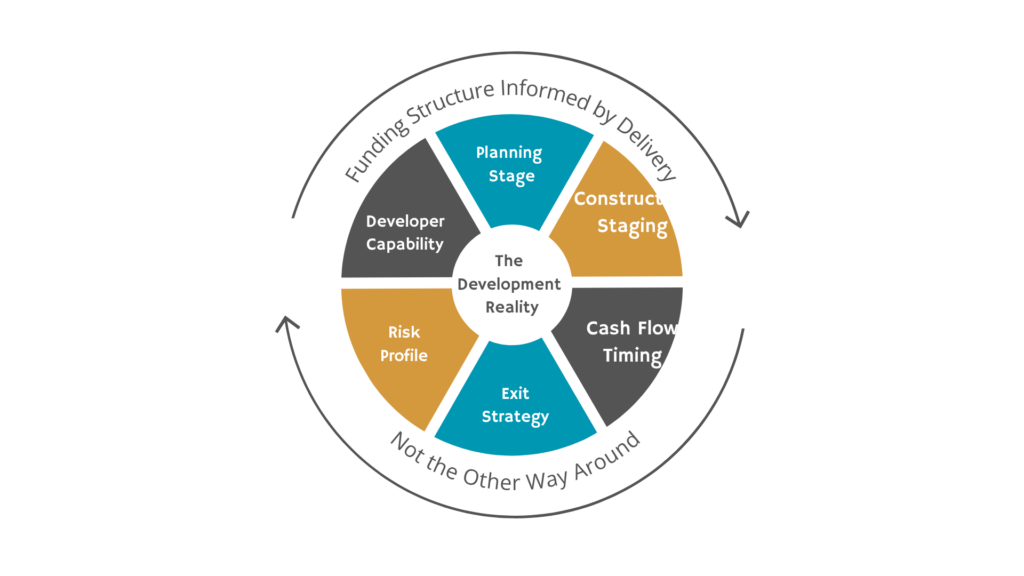
One of the most common mistakes developers make when sourcing property development finance Australia wide is starting with the funding product rather than the development itself. While it can be tempting to focus on leverage, pricing, or lender appetite early, effective construction and development finance must always be structured around the real-world delivery of the project.
Every development carries its own risk profile, timing constraints, and sequencing challenges. Planning status, approval pathways, construction complexity, staging requirements, cash flow timing, drawdown mechanics, exit strategy, market exposure, and developer capability all materially influence what type of funding structure will actually work. Ignoring these fundamentals can lead to funding arrangements that look attractive on paper but create friction once the project moves into delivery.
A funding structure that suits a fully DA-approved residential project may be entirely inappropriate for a site with planning risk, early works requirements, or a staged construction program. The right private funder is not the one offering the most aggressive terms, but the one whose capital genuinely aligns with how the development will be delivered from acquisition through to completion.
Interest Rates Matter However Structure Matters More
Headline interest rates are often the first thing developers compare when assessing private property development finance, but they rarely tell the full story. In practice, the structure of the facility and how it interacts with the development is often far more important than the headline price.
When reviewing non-bank development finance, developers should work through the following checklist and ask whether each element genuinely aligns with their project:
- Fee transparency: Are establishment, line, and exit fees clearly defined, fully disclosed, and understood upfront with no ambiguity around when they apply?
- Interest treatment: Does the facility allow interest to be capitalised where appropriate, or is interest required to be serviced in a way that aligns with the project’s cash flow profile?
- Drawdown mechanics: Are drawdowns structured to reflect how construction will actually progress, with practical certification requirements that won’t slow delivery?
- Covenant flexibility: Do the covenants allow for realistic movement in program timing, costs, or staging without triggering unnecessary defaults?
- Reporting obligations: Are reporting requirements proportionate to the project size and complexity, or are they likely to create administrative friction?
- Extension and refinance options: Are extension terms, refinance pathways, and exit conditions clearly defined and achievable based on realistic market assumptions?
If developers can confidently tick off most of these points, the funding structure is likely aligned. If several require further clarification or negotiation, it’s often a sign the facility may create friction during delivery.
A marginally higher interest rate paired with realistic covenants, flexible drawdowns, and clear extension pathways will often deliver a stronger outcome than a cheaper but rigid facility. In non-bank development finance, structure and flexibility frequently outweigh headline cost.
Understanding Development Risk Is Critical
One of the key advantages of private development funding is that private lenders are not bound by the same rigid policies as traditional banks, allowing them to assess projects on their individual merits. However, not all private funders specialise in the same types of developments.
Some lenders are better suited to straightforward DA-approved residential projects, while others are more comfortable supporting staged delivery programs, early works, or projects still progressing through approvals. Aligning with a funder experienced in your specific project type can save significant time during the funding process and reduce friction throughout the life of the development.
This is particularly relevant when seeking property development funding in Sydney, for example, where planning pathways, consultant coordination, and construction sequencing often evolve as projects move toward delivery. A lender familiar with these realities is far more likely to work constructively with normal program adjustments rather than treat them as unexpected risk. Choosing a funder with the right experience for the project can make a meaningful difference to both funding certainty and overall delivery confidence.
Term Sheets Do Not Equal Funding Approval
A critical point often misunderstood by developers is the role of a term sheet.
While receiving a term sheet may feel like a major milestone, a term sheet does not mean funding has been approved.
In most cases, term sheets are:
- Indicative only
- Subject to due diligence
- Conditional on valuation, QS review, legal documentation, and credit approval
Many projects stall or face renegotiation because developers assume a term sheet represents certainty, only to discover that material conditions remain outstanding. Understanding the difference between indicative support and committed capital is essential when planning acquisitions, settlements, and construction programs.
Experienced development management ensures funding assumptions are realistic and that project timelines are not built on conditional approvals.
Aligning Funding with the Exit Strategy
Every private funding facility is ultimately assessed against its exit. Whether the exit is a sell-down, refinance to bank funding, or long-term hold, alignment between the funder’s expectations and the project’s realistic delivery timeframe is essential.
It is essential that developers ensure loan terms align with planning and construction programs, extension options are clearly defined and exit assumptions reflect real market conditions. In addition to this it is imperative that refinance pathways are achievable, not just theoretical.
Misalignment here is one of the most common causes of stress in private property development finance and one of the easiest to avoid with proper upfront planning.
The Role of Development Management in Funding Selection
Choosing the right private funder is not just a finance decision, it is a development management decision.
At 756Group, we assess property development finance Australia wide as part of an integrated, end-to-end development strategy. We don’t just look at whether funding is available, we assess whether it genuinely supports how the project will be delivered.
Our role includes:
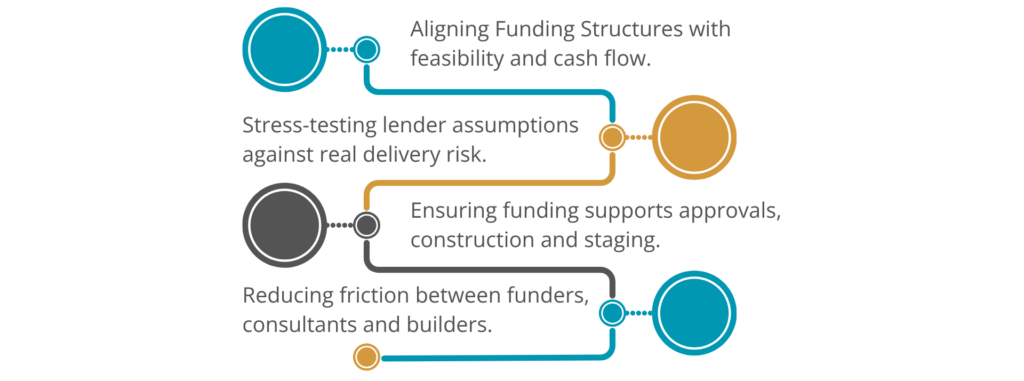
By integrating construction and development finance with practical development management, we improve certainty, protect feasibility, and keep projects moving in the right direction.
Final Thoughts
Private property development finance in Australia is a powerful tool but only when it is aligned with the project and the developer behind it. The best outcomes are rarely driven by interest rates alone, they come from selecting the right private funder, understanding the conditions behind term sheets, and ensuring funding structures reflect real-world delivery.
When structured correctly, private development funding, non-bank development finance, and tailored development funding solutions don’t just fund projects, they enable successful outcomes.